
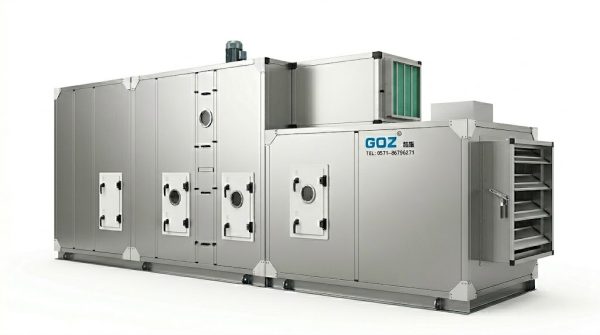
GZF Series Split-Type Marine Coating Dehumidification System
The GZF Series Split-Type Marine Coating Dehumidification System is specially designed by GOZ for shipbuilding, steel structure, sandblasting, and painting applications. Combining refrigeration dehumidification and desiccant rotor technology, the system provides highly efficient humidity control, cooling, heating, and ventilation functions for demanding industrial environments.
With separate indoor and outdoor units, the system offers flexible installation options and reliable operation under harsh conditions. It is capable of operating continuously throughout the year, effectively controlling humidity, preventing steel surface flash rust, and significantly improving coating quality and construction efficiency.
Product Parameters
| GZF Industrial Marine Coating Dehumidification System (Split-Type) | ||||||||||
| Component | Parameter | Unit | GZF-9000 | GZF-12000 | GZF-15000 | GZF-18000 | GZF-22000 | GZF-25000 | GZF-30000 | GZF-36000 |
| Overall Unit Perf. |
Process Air Vol. | m³/h | 9000 | 12000 | 15000 | 18000 | 22000 | 25000 | 30000 | 36000 |
| Cooling Cap. | kW | 180 | 240 | 300 | 360 | 430 | 480 | 580 | 650 | |
| Heating Cap. | kW | 60 | 80 | 100 | 120 | 140 | 160 | 200 | 230 | |
| Ctrl Range (T/RH) | – | T = 18~25℃ ±3℃, RH ≤ 45% | ||||||||
| Operating Temp. | – | T = -5~40℃, RH ≤ 95% | ||||||||
| ESP (Static Pres.) | Pa | ≥ 1200 | ||||||||
| Power Supply | – | 50Hz, 380V, 3PH 4-Wire / 3PH 3-Wire | ||||||||
| Rated Max Power | kW | 143 | 188 | 231 | 256 | 286 | 314 | 391 | 421 | |
| Unit Noise Level | dB(A) | 75 | 77 | 79 | 80 | 80 | 82 | 82 | 82 | |
| Process Air System |
Air Filter Type | – | Metal Mesh Panel Filter | |||||||
| Fan Type | – | Low-Noise Centrifugal Fan | ||||||||
| Fan Quantity | Set | 1 | ||||||||
| Fan Power | kW | 11 | 15 | 18.5 | 18.5 | 23.5 | 23.5 | 27 | 30 | |
| React. Air System |
Air Filter Type | – | Metal Mesh Panel Filter | |||||||
| Fan Type | – | Single-Inlet Direct-Drive Centrifugal Fan | ||||||||
| Fan Quantity | Set | 1 | ||||||||
| Fan Power | kW | 1.5 | 2.2 | 3 | 3 | 4 | 5 | 7.5 | 7.5 | |
| React Heat Power | kW | 45 | 60 | 75 | 90 | 112 | 123 | 150 | 168 | |
| Rotor System |
Rotor Type | – | HPS (High-Efficiency Silica Gel) | |||||||
| Rotor Motor Power | kW | 0.06 | 0.06 | 0.09 | 0.1 | 0.1 | 0.1 | 0.1 | 0.1 | |
| Refrig. System |
Compressor Type | – | Semi-Hermetic Screw Compressor | |||||||
| Compressor Qty | Set | 1 | 1 / 2 | |||||||
| Compressor Power | kW | 45 | 60 | 75 | 90 | 110 | 120 | 150 | 180 | |
| Condenser Type | – | Copper Tube with Aluminum Fin Type | ||||||||
| Condenser Fan Type | – | Axial Flow Type | ||||||||
| Condenser Fan Qty | Set | 3 | 3 | 3 | 3 | 6 | 6 | 6 | 6 | |
| Condenser Power | kW | 6 | 9 | 10.5 | 10.5 | 13.2 | 13.2 | 16.8 | 22 | |
| Evaporator Type | – | Copper Tube with Aluminum Fin Type | ||||||||
| Refrigerant Type | – | R22 / R410a / R134a / R407C | ||||||||
| Throttling Method | – | Thermal Expansion Valve (TXV) | ||||||||
| Heating System |
Heater Type | – | Electric Heating | |||||||
| Elec Heat Power | kW | 57 | 79 | 96 | 120 | 135 | 156 | 183 | 216 | |
| Main Process Dim. |
Length | mm | 4800 | 4800 | 5100 | 5100 | 5100 | 6000 | 6000 | 6000 |
| Width | mm | 1940 | 1940 | 2240 | 2240 | 2240 | 2240 | 2240 | 2240 | |
| Height | mm | 2665 | 2665 | 3130 | 3130 | 3130 | 3130 | 3130 | 3130 | |
| Net Weight | kg | 4200 | 4500 | 4800 | 5200 | 5400 | 5800 | 6200 | 6500 | |
| Outlet Spec. | mm | 500×500 | 550×550 | 600×600 | 600×600 | 650×650 | 700×700 | 755×755 | 850×850 | |
| Cond. Unit Dim. |
Length | mm | 2275 | 2275 | 3340 | 3340 | 3340 | 4400 | 4600 | 4600 |
| Width | mm | 2000 | 2000 | 2000 | 2000 | 2000 | 2000 | 2000 | 2000 | |
| Height | mm | 2445 | 2445 | 2350 | 2350 | 2350 | 2350 | 2350 | 2350 | |
| Net Weight | kg | 1100 | 1200 | 1400 | 1600 | 1800 | 2100 | 2400 | 2800 | |
How the Industrial Marine Coating Dehumidification System Works
The Industrial Marine Coating Dehumidification System works by combining two dehumidification stages: refrigeration dehumidification and desiccant wheel adsorption. In the first stage, humid air passes through an evaporator where moisture is condensed and removed. In the second stage, the air passes through a silica gel desiccant rotor to achieve deeper dehumidification.
This dual-process design allows the system to maintain low humidity levels even in challenging conditions such as coastal environments, rainy seasons, or enclosed large-volume workshops.
After dehumidification, the air is reheated and supplied back into the workspace through high static pressure ducts to ensure uniform air distribution.
Product Features
Dual Dehumidification Technology
The Industrial Marine Coating Dehumidification System combines refrigeration dehumidification and rotary desiccant dehumidification technology, achieving high energy efficiency and stable low humidity control under different climate conditions.
All-Season Stable Operation
The Industrial Marine Coating Dehumidification System Designed for year-round operation, the unit can handle inlet air conditions from -10°C to 40°C with relative humidity from 60% to 95%, providing stable outlet air conditions of 25±3°C and RH ≤45%.
High Performance Desiccant Rotor
The moisture removal core adopts a high-quality silica gel desiccant rotor, providing excellent adsorption performance, long service life and reliable low humidity control.
High Efficiency Refrigeration System
The refrigeration system uses high-performance semi-hermetic twin screw compressors, ensuring stable operation, high efficiency and long maintenance intervals.
Intelligent Control System
The Industrial Marine Coating Dehumidification System Equipped with automatic and manual control modes, the system allows easy operation, precise parameter adjustment and reliable unattended operation.
Winter Reheating Function
The built-in reheating system improves outlet air temperature during cold weather conditions, ensuring suitable temperature and humidity conditions for painting processes.
Industrial Safety Protection
The Industrial Marine Coating Dehumidification System is equipped with comprehensive protection functions including:
- Electrical leakage protection
- Phase sequence and phase loss protection
- Low voltage protection
- Overload protection
- High and low refrigerant pressure protection
High Static Pressure Air Supply
The high external static pressure fan allows stable airflow delivery through long flexible ducts or complex air distribution systems.
Multiple air outlets can be independently adjusted to support different working areas.
Applications
- Shipyard sandblasting rooms
- Marine painting workshops
- Marine Coating workshops
- Steel structure surface preparation
- Offshore platform maintenance
- Heavy-duty anti-corrosion coating projects
- Large industrial painting facilities
Core Advantages
- Stable all-season humidity control
- Prevents flash rust after sandblasting
- Improves coating adhesion and painting quality
- Suitable for harsh marine environments
- High airflow capacity for large working spaces
- Reliable 24/7 industrial operation
- Flexible split-type installation design
Industrial Marine Coating Dehumidification System Overview
The Industrial Marine Coating Dehumidification System is a professional humidity control solution designed for shipyards, steel structure workshops, offshore platforms, and large industrial coating environments. It integrates refrigeration dehumidification and desiccant rotor technology to achieve stable low humidity conditions even in high-moisture coastal climates.
Unlike conventional dehumidifiers, this system is engineered for continuous 24/7 operation in large-scale industrial spaces. It ensures consistent air conditions during surface preparation, sandblasting, and coating processes, helping prevent flash rust and coating failures.
The system is widely used in modern shipbuilding and heavy-duty anti-corrosion projects where strict environmental control is required for coating quality and long-term durability.
Product Value
The GZF Series Split-Type Industrial Marine Coating Dehumidification System provides reliable humidity control solutions for modern shipyards and industrial coating applications.
By maintaining proper temperature and humidity conditions, it helps reduce corrosion risks, improve coating performance and increase production efficiency.
Frequently Asked Questions (FAQ)
What is an Industrial Marine Coating Dehumidification System?
It is an industrial-grade humidity control system designed to maintain low humidity conditions in painting and coating environments such as shipyards, steel structure workshops, and offshore platforms.
Why is humidity control important in painting workshops?
High humidity can cause flash rust, poor coating adhesion, blistering, and premature coating failure. Proper humidity control ensures coating quality and extends the lifespan of protective layers.
What humidity level is required for industrial painting?
Most industrial painting applications require relative humidity below 50%, typically around 40–45% RH for optimal coating performance.
Can the system operate in coastal or marine environments?
Yes. The system is specifically designed for high-humidity coastal environments such as shipyards and offshore platforms, ensuring stable performance even under harsh conditions.
What is the difference between refrigeration and desiccant dehumidification?
Refrigeration dehumidification removes moisture by cooling air below dew point, while desiccant dehumidification uses a silica gel rotor to absorb moisture. The combination provides higher efficiency and better low-humidity performance.
Can the system run continuously?
Yes. The system is designed for 24/7 continuous industrial operation with high reliability and low maintenance requirements.
For more information about humidity control standards,please refer to ASHRAE.
Related Keywords
- Industrial Painting Dehumidifier System
- Shipyard Humidity Control System
- Industrial Coating Dehumidification System
- Marine Painting Humidity Control Equipment
- Steel Structure Painting Dehumidifier
- Blast Room Dehumidification System
- Anti-corrosion Coating Environment Control