
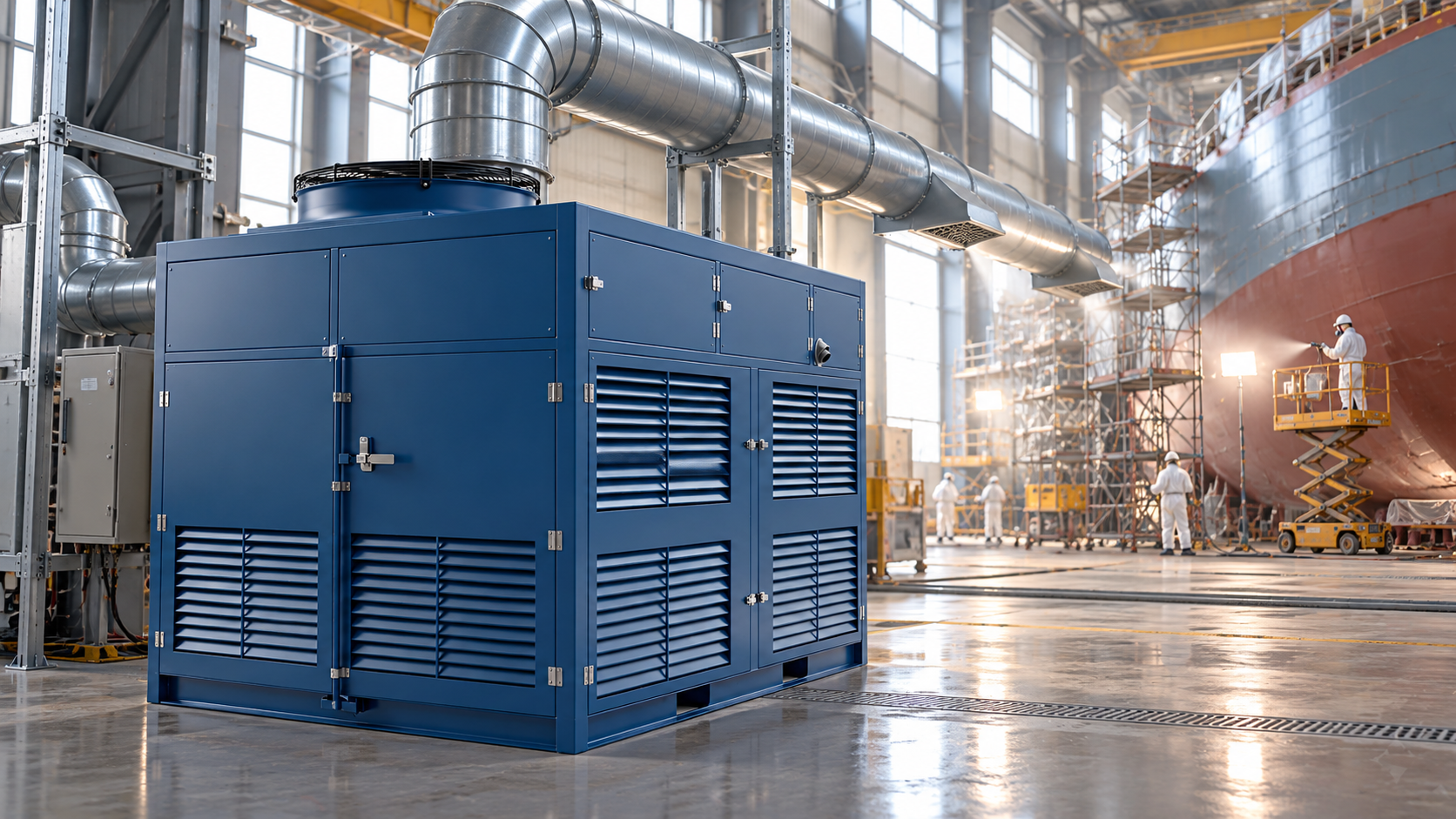
A shipbuilding type dehumidifier is designed to control moisture across large, changing shipyard work zones—especially during steel preparation, abrasive blasting, priming and coating. In these environments, humidity and steel temperature affect coating quality, worker schedules and the risk of flash rust. The right system helps create a more predictable application window instead of relying on weather alone.
Why shipbuilding needs dedicated humidity control
Shipbuilding and ship repair combine enormous surface areas with open doors, moving vessels and frequent ventilation changes. Coastal air can carry high moisture, while blasting and coating schedules may require stable conditions for long periods. A small portable unit may be suitable for a limited enclosure, but large hull sections, blasting halls and dockside containment often need engineered airflow and capacity matched to the actual space.
Before coating, teams typically review the coating manufacturer’s requirements and measure ambient temperature, relative humidity, steel temperature and dew point. Dehumidification should be selected as part of that process—not as a substitute for measurement or the coating supplier’s specifications.
How a shipbuilding type dehumidifier supports blasting and coating
- More consistent conditions: Dry-air delivery can help maintain a controlled environment around the work area as outside conditions change.
- Support for surface preparation: Managing moisture can reduce the likelihood of condensation on prepared steel when the process is properly monitored.
- Flexible coverage: Ducted systems can direct air to an enclosure, workshop or vessel section; the layout should avoid short-circuiting supply air back to the return.
- Schedule resilience: A planned humidity-control system can help reduce weather-related interruptions, subject to the coating system’s limits and site conditions.
What to specify before choosing equipment
Start with the controlled volume and the real operating conditions. Record the enclosure dimensions, target temperature and humidity, outdoor design conditions, air leakage, ventilation rate, process moisture loads and required operating hours. Also consider whether the unit must be moved between docks, how ducts will be routed, available electrical power, noise limits, maintenance access and condensate handling where applicable.
Capacity should be engineered from these inputs. Nameplate extraction figures alone do not describe performance in a cold, leaky or highly ventilated shipyard. Ask the supplier to explain the design assumptions, airflow, expected operating range, control strategy and commissioning measurements. Confirm compatibility with the site’s coating procedures and safety requirements.
Desiccant or condensation-based dehumidification?
The best technology depends on temperature, target dew point, ventilation and energy priorities. Desiccant systems can be useful where low dew points or lower-temperature operation are important; condensation-based equipment may suit other temperature and humidity ranges. A project assessment should compare the required leaving-air condition, heat effects, power demand, installation constraints and lifecycle maintenance rather than selecting on technology name alone.
Plan the system around the work zone
For a shipyard project, define the boundary of the controlled zone first. Place supply and return paths to promote even circulation, protect equipment from abrasive dust, and coordinate duct routing with cranes, access platforms and blasting operations. Use calibrated instruments at representative locations, including near the steel surface, and keep records through preparation and coating. Commissioning under actual site conditions is essential to confirm that the system can meet the agreed targets.
For a purpose-built solution, review our shipyard painting dehumidifier system. Share the project volume, target conditions, ventilation and schedule so the equipment configuration can be assessed for your application.
Frequently asked questions
Can one dehumidifier cover an entire vessel?
It depends on the controlled volume, enclosure and air exchange. Large vessels are commonly divided into zones, with capacity and ducting planned for each operating area.
What humidity should blasting or coating maintain?
Follow the paint and coating manufacturer’s technical data and project specification. Measure relative humidity, steel temperature and dew point at the work area; there is no single safe setpoint for every coating.
Is equipment capacity based only on room size?
No. Volume is only one input. Air leakage, outdoor air, target conditions, temperature and process loads can significantly change the required capacity.
Conclusion
A shipbuilding type dehumidifier is most effective when selected as part of a measured environmental-control plan. Define the work zone, calculate the moisture load, design the airflow and verify conditions during operation. This turns humidity control into a repeatable part of shipbuilding surface preparation and coating management.
Related Products & Applications
shipyard painting dehumidifier · marine coating dehumidification system