
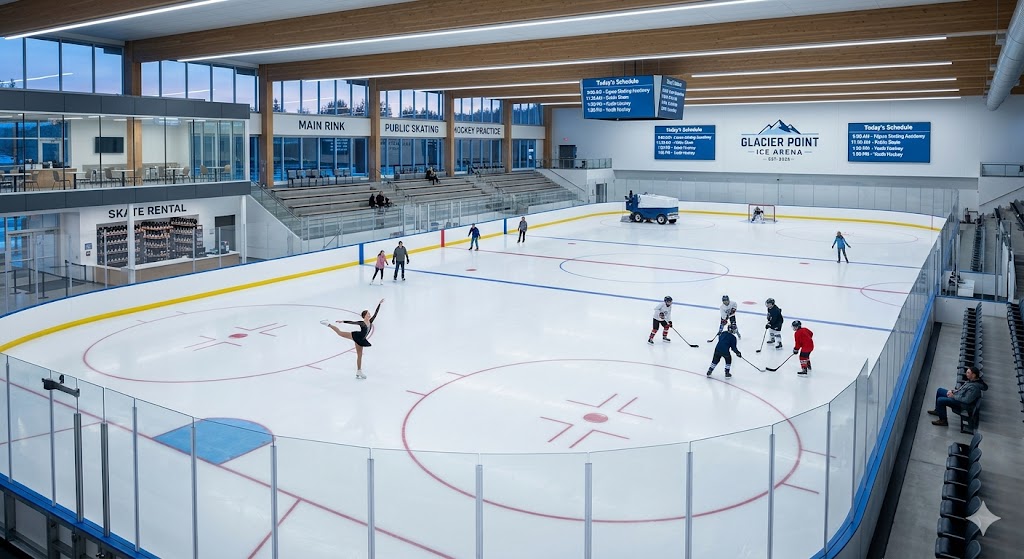
Ice Rink Dehumidification System for Ice Arena Applications
Ice Rink Dehumidification System is an advanced humidity control solution designed for indoor ice rinks, hockey arenas, skating facilities, and winter sports venues.
Because ice surfaces operate at extremely low temperatures while surrounding air is warm and humid, moisture easily condenses on:
- Ice surfaces
- Ceilings and steel structures
- Glass panels and lighting systems
- Refrigeration and mechanical equipment
This leads to fog formation, frost buildup, poor ice quality, and increased energy consumption.
Gaozhen’s rotary desiccant dehumidifier uses advanced adsorption technology to continuously remove moisture from the air. By precisely controlling humidity and dew point temperature, the system ensures a stable, dry, and controlled environment for ice rink operations.
Ice Rink Humidity and Condensation Problems
Ice rink facilities commonly face:
- Fog formation above ice surface
- Frost buildup on ice and equipment
- Condensation on ceilings and structures
- Ice surface softening and instability
- Increased refrigeration load and energy use
These issues directly affect ice quality, visibility, and operational efficiency.
Why Ice Rink Needs Humidity Control System
Due to the large temperature difference between ice surfaces and ambient air, humidity naturally condenses and freezes.
Without an effective Ice Rink Dehumidification System, facilities may experience:
- Poor skating performance conditions
- Reduced ice hardness and smoothness
- Frequent defrost and maintenance cycles
- Higher operational energy costs
Rotary Desiccant Dehumidification Solution
Gaozhen’s rotary desiccant dehumidifier provides continuous humidity control for ice rink environments.
The system works by:
- Removing moisture from incoming air
- Lowering dew point temperature
- Preventing condensation and fog formation
- Maintaining stable indoor humidity levels
Unlike conventional cooling-based systems, rotary desiccant technology performs efficiently in low-temperature environments.
H2:Benefits of Ice Rink Dehumidification System
A properly designed humidity control system provides:
- Eliminates fog and improves visibility
- Prevents frost formation on ice surfaces
- Maintains stable ice quality and performance
- Reduces condensation on building structures
- Improves refrigeration efficiency
- Reduces energy consumption and operating costs
- Enhances athlete and visitor experience
Applications in Ice Sports Facilities
Ice Rink Dehumidification Systems are widely used in:
- Indoor ice skating rinks
- Ice hockey arenas
- Winter sports centers
- Training ice rinks
- Commercial ice entertainment facilities
- Professional competition venues
- Indoor stadium ice areas
Customized Ice Rink Humidity Control Solutions
Different ice rink projects require different humidity control strategies.
Gaozhen provides customized rotary desiccant dehumidification solutions based on:
- Ice rink size and layout
- Refrigeration system conditions
- Local climate and humidity levels
- Operational and occupancy requirements
Our solutions ensure stable humidity control, improved ice quality, reduced energy consumption, and long-term reliable operation of ice sports facilities.
FAQ – Ice Rink Dehumidification System
Q1: Why does fog appear in ice rinks?
Fog is caused by warm humid air contacting the cold ice surface and condensing.
Q2: What causes frost on ice surfaces?
High humidity in the air freezes when it touches the cold ice surface.
Q3: What is the best humidity control system for ice rinks?
Rotary desiccant dehumidification systems are the most effective solution.
Q4: Can dehumidifiers improve ice quality?
Yes, controlling humidity improves ice hardness, smoothness, and stability.
CTA
👉 Request Ice Rink Dehumidification Solution
👉 Get Technical Proposal for Your Arena
👉 Contact Engineering Team Today
ASHRAE Handbook – HVAC Systems and Humidity Control Resources
https://www.ashrae.org/technical-resources/ashrae-handbook