
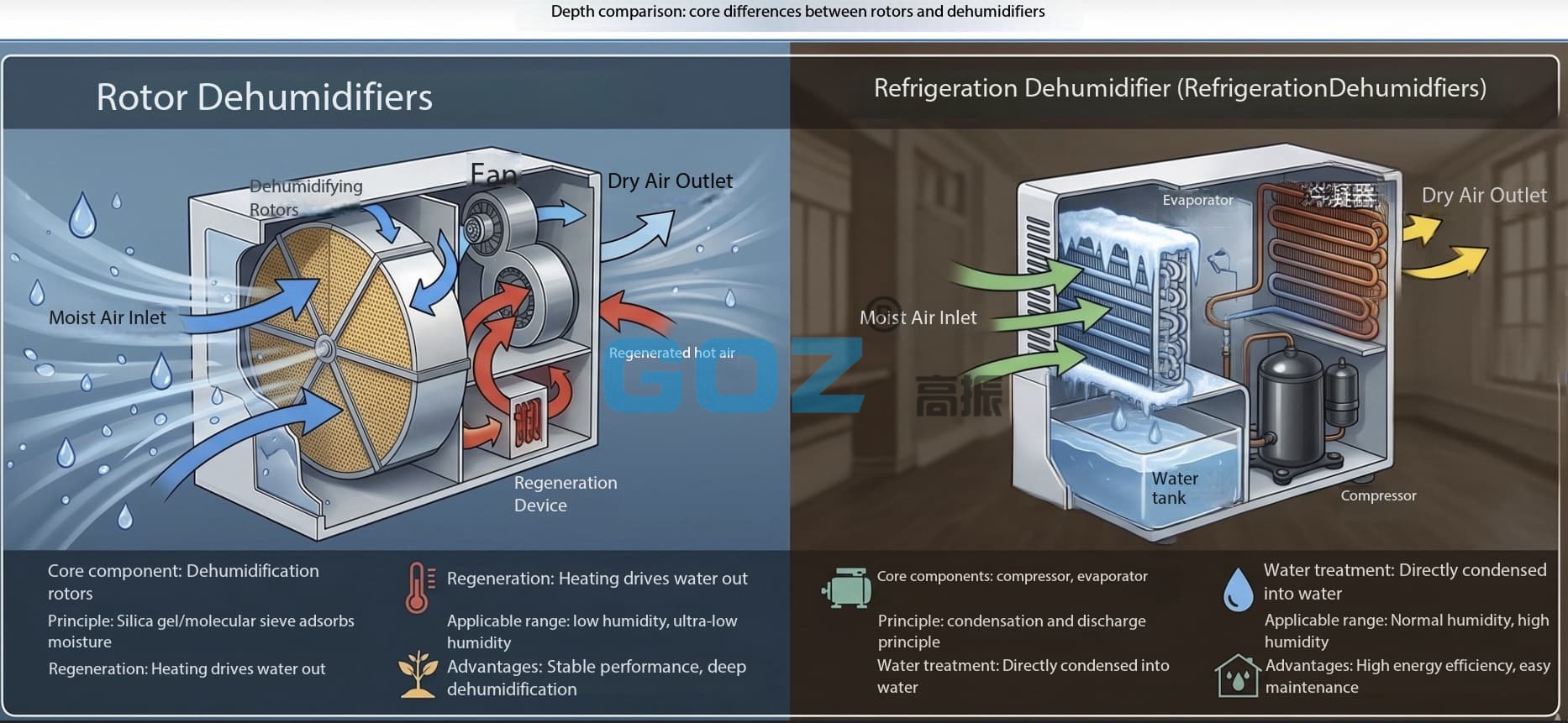
When selecting an industrial dehumidifier, one of the most common questions is Desiccant Dehumidifier vs Refrigerant Dehumidifier: which technology is better for your application?
Both systems are designed to remove moisture from the air, but they use completely different dehumidification methods and provide different performance levels in industrial environments.
Understanding the differences between a desiccant dehumidifier and a refrigerant dehumidifier helps engineers and facility managers select the most efficient humidity control solution, reduce energy consumption, and improve production reliability.
What Is a Refrigerant Dehumidifier and How Does It Work?
A refrigerant dehumidifier, also known as a refrigeration dehumidifier, removes moisture through a cooling and condensation process.
When humid air enters the unit, it passes across a cold evaporator coil. The air temperature is reduced below its dew point, causing water vapor to condense into liquid water. The condensed water is collected and drained, while the dried air is reheated before returning to the space.
Refrigerant dehumidifiers are effective for environments with:
- Moderate temperatures
- Medium to high relative humidity
- General moisture control requirements
Typical applications include:
- Warehouses
- Commercial buildings
- Storage rooms
- Basements
- General industrial spaces
However, refrigeration-based systems become less efficient when extremely low humidity or low dew point conditions are required.
What Is a Desiccant Dehumidifier and How Does It Work?
A desiccant dehumidifier removes moisture through adsorption technology rather than condensation.
The humid air passes through a rotating desiccant wheel containing highly hygroscopic materials such as silica gel. Moisture molecules are captured by the desiccant material, while a separate heated regeneration airflow continuously removes the absorbed moisture from the rotor.
This continuous adsorption and regeneration process allows the system to provide stable dehumidification performance even in:
- Low temperature environments
- Low humidity conditions
- Ultra-low dew point applications
Desiccant dehumidifiers are widely used in industries where moisture control directly affects product quality and production reliability.
Desiccant Dehumidifier vs Refrigerant Dehumidifier: Key Differences
1. Moisture Removal Performance
The biggest difference between a desiccant dehumidifier and a refrigerant dehumidifier is their ability to achieve low humidity levels.
Refrigerant dehumidifiers typically perform best when maintaining humidity levels around:
- 40–60% RH
When lower humidity is required, refrigeration systems lose efficiency because condensation becomes increasingly difficult.
Desiccant dehumidifiers can achieve much lower humidity levels:
- Below 40% RH
- Below 20% RH
- Low dew point conditions
- Dew points down to -40°C or lower with specialized systems
This makes desiccant technology the preferred choice for moisture-sensitive industries.
2. Operating Temperature Range
Another important factor in the Desiccant Dehumidifier vs Refrigerant Dehumidifier comparison is operating temperature.
Refrigerant dehumidifiers depend on cooling coils. In cold environments, frost can form on the evaporator coil, reducing moisture removal capacity and requiring frequent defrost cycles.
Desiccant dehumidifiers do not rely on refrigeration coils for moisture removal.
They can maintain stable performance in:
- Cold storage areas
- Outdoor equipment rooms
- Winter conditions
- Temperature-variable environments
3. Dew Point Capability
Dew point control is critical for advanced manufacturing processes.
Refrigerant dehumidifiers are normally limited to standard humidity control applications.
Desiccant dehumidification systems are designed for applications requiring:
- Low dew point air
- Ultra-dry environments
- Moisture-sensitive production processes
Typical applications include:
- Lithium battery dry rooms
- Semiconductor manufacturing
- Electronics production
- Pharmaceutical clean rooms
4. Energy Efficiency and Long-Term Cost
The initial investment of a desiccant dehumidifier is usually higher than a refrigerant system.
However, for industrial applications requiring continuous low humidity control, desiccant systems can provide:
- More stable production conditions
- Reduced moisture-related defects
- Lower product loss risk
- Improved equipment reliability
Choosing the correct technology based on application requirements is often more economical than selecting a system based only on initial equipment cost.
Industrial dehumidifier Applications Comparison
Refrigerant Dehumidifier Applications
Refrigerant systems are commonly used for:
- Warehouses
- Commercial spaces
- Storage facilities
- General manufacturing areas
- Indoor humidity control
Desiccant Dehumidifier Applications
Desiccant systems are preferred for industries requiring precise humidity control:
Lithium Battery Manufacturing
Battery production requires extremely dry environments to prevent moisture contamination.
Applications include:
- Battery dry rooms
- Electrode manufacturing
- Cell assembly areas
Electronics Manufacturing
Electronic components require protection against:
- Condensation
- Corrosion
- Electrical failures
Applications include:
- Electronics rooms
- Control cabinets
- Semiconductor facilities
Pharmaceutical and Cleanroom Applications
Stable humidity control helps maintain:
- Product quality
- Process consistency
- Manufacturing standards
Marine and Industrial Protection
Desiccant dehumidifiers are widely used for:
- Shipyard painting
- Steel corrosion prevention
- Bridge protection
- Offshore equipment
Which Dehumidifier Should You Choose?
The choice between a Desiccant Dehumidifier vs Refrigerant Dehumidifier depends on your humidity target, temperature conditions, and application requirements.
Choose a Refrigerant Dehumidifier When:
✔ Required humidity is above 40% RH
✔ Temperature conditions are stable
✔ Standard moisture control is sufficient
✔ Initial equipment cost is the main consideration
Choose a Desiccant Dehumidifier When:
✔ Humidity below 40% RH is required
✔ Low dew point air is needed
✔ The system operates continuously
✔ Temperature conditions are challenging
✔ Product quality depends on humidity accuracy
GOZ Industrial Desiccant Dehumidification Solutions
GOZ specializes in industrial desiccant dehumidification systems designed for demanding humidity control applications.
Our solutions include:
- Industrial desiccant dehumidifiers
- Low dew point dehumidification systems
- Lithium battery dry room dehumidifiers
- Electronics humidity control systems
- Customized industrial moisture control solutions
Compared with conventional refrigeration systems, GOZ desiccant technology provides reliable moisture removal for industries where precise humidity control is essential.
Conclusion: Desiccant Dehumidifier vs Refrigerant Dehumidifier
Both desiccant and refrigerant dehumidifiers have their advantages.
Refrigerant dehumidifiers are suitable for general humidity control applications where moderate moisture removal is required.
Desiccant dehumidifiers are the better choice for industrial environments requiring:
- Ultra-low humidity
- Low dew point conditions
- Stable year-round operation
- Protection of sensitive products and equipment
For industries such as lithium battery manufacturing, electronics, pharmaceuticals, aerospace, and marine protection, desiccant dehumidification technology provides a more reliable solution for modern industrial humidity control.
For more information about humidity control standards,please refer to ASHRAE.