
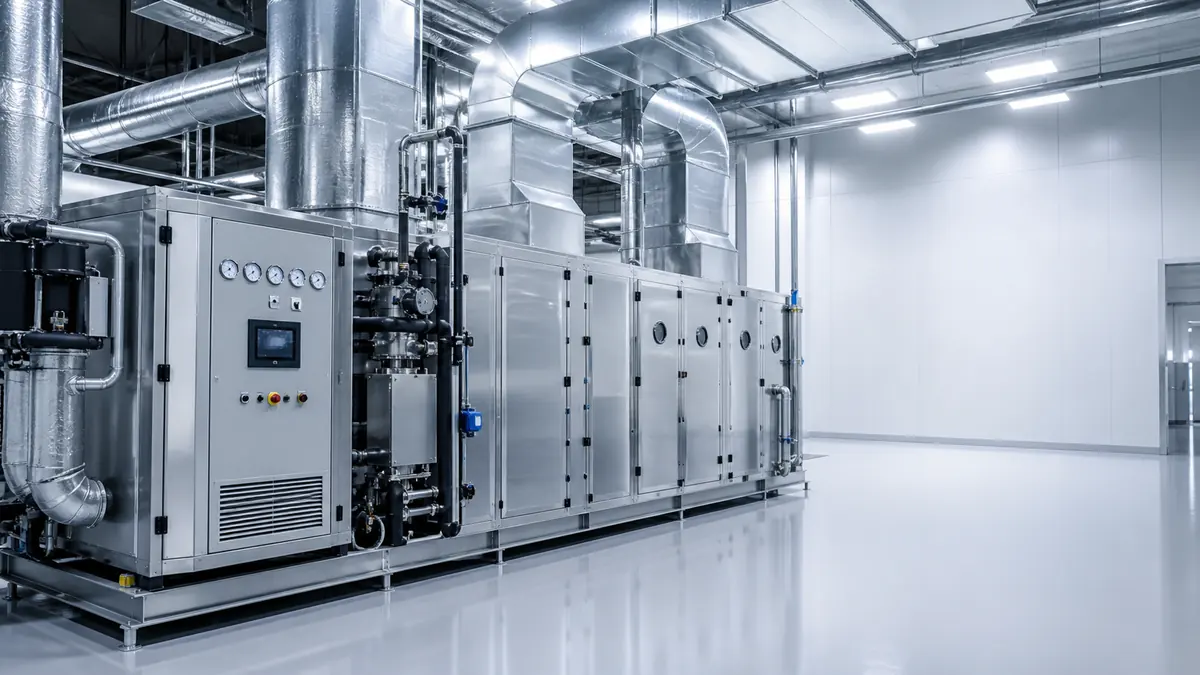
Selecting a low dew point dehumidifier is a process-design decision, not simply an equipment purchase. The right system must maintain the required dew point under the real moisture load, airflow, ambient conditions and operating schedule of the facility.
Define the Required Dew Point
Start with the required supply-air dew point, not only the room relative-humidity target. Battery dry rooms and other moisture-sensitive processes may require -40°C to -60°C conditions, while less demanding processes may need a different design point. The design basis should state the target at the point of use, the tolerance, and the operating conditions under which it must be maintained.
Determine Airflow and Moisture Load
A low dew point dehumidifier must be sized for the total moisture entering the space. Record process airflow in m³/h, outdoor-air fraction, infiltration through doors and leaks, people, wet materials, process exhaust and the desired recovery time after disruption. Undersizing can cause unstable dew point; oversizing can increase first cost and regeneration energy.
Specify Regeneration Energy and Energy Strategy
Desiccant rotor systems need regeneration energy to release captured moisture. Confirm the available energy source, its temperature, operating cost and reliability. A useful comparison also considers heat recovery, airflow matching, control logic and part-load operation—not only the equipment nameplate.
Check Controls, Testing and Reliability
For demanding dry rooms, specify dew-point sensing range, control accuracy, alarm thresholds, trend data and the response required after a door opening or production change. Ask how performance is verified during commissioning and what maintenance access is required for filters, rotors, fans and sensors.
Review System Integration and Installation Constraints
The dehumidifier is part of the wider air-handling system. Check duct routes, outdoor-air treatment, return-air paths, available floor space, service clearance, electrical supply, drainage, heat rejection and integration with HVAC or cleanroom controls. Early coordination prevents costly rework during installation.
Prepare a Complete Request for Proposal
A useful request for proposal includes the application, target dew point, airflow, ambient design data, occupancy or process schedule, external air conditions, utility availability, installation limits and desired commissioning scope. With these inputs, suppliers can propose comparable technical solutions instead of relying on assumptions.
Low Dew Point Dehumidifier Selection Checklist
- Required supply-air dew point and allowable tolerance
- Process airflow, outdoor-air fraction and infiltration estimate
- Moisture sources from people, materials and process exhaust
- Available regeneration energy and expected operating schedule
- Controls, monitoring, alarms and commissioning requirements
- Ductwork, service access and HVAC or cleanroom integration
Build the Right Dry-Room Specification
A complete selection basis helps technical teams compare low dew point dehumidifier options on performance, operating conditions and lifecycle value. For related solutions, review our low dew point desiccant dehumidifier product page, lithium battery dry room application and ultra-low dew point dehumidifier guide before requesting a technical proposal.
Avoid These Common Selection Errors
Do not specify a system only by a brochure dew-point figure. The result depends on inlet conditions, airflow, regeneration energy, controls and the actual moisture load. Another common error is treating room relative humidity as a substitute for dew point, or ignoring infiltration during production and maintenance. A sound specification describes the required operating point and the test conditions used to verify it.
Use the Right Data for Supplier Comparison
When comparing proposals, confirm that each supplier has used the same design data and system boundary. Check whether quoted airflow includes outdoor air, whether regeneration energy is included, and whether testing, controls, installation and commissioning are within scope. This makes capital cost, energy use and performance comparisons more meaningful for the project team.
For a tailored technical proposal, provide the full design basis early so the selected system can be assessed against real operating conditions, not only nominal catalogue performance.