
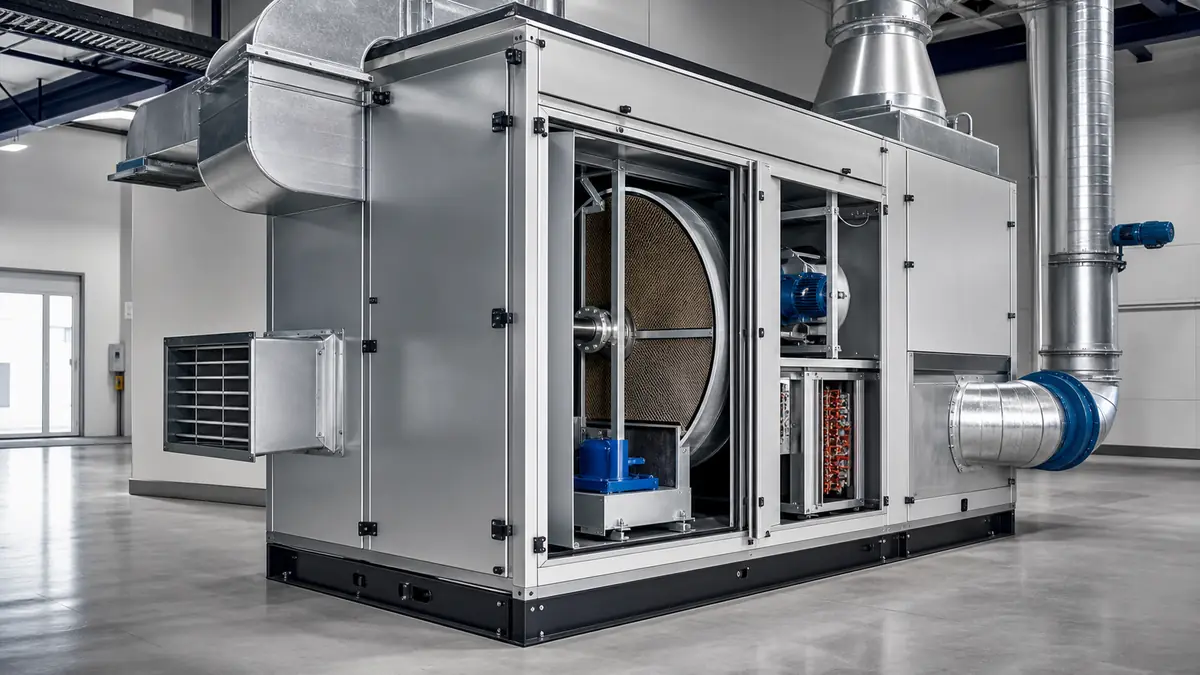
A rotary dehumidifier uses a slowly rotating desiccant wheel to remove water vapor from industrial air. Unlike a refrigeration unit, it does not depend on cooling air below its dew point. This makes rotary desiccant technology especially useful when a process needs low relative humidity, a low dew point, or stable performance at low temperature.
Industrial users commonly apply rotary dehumidifiers in lithium battery dry rooms, pharmaceutical production, electronics manufacturing, cold storage, shipyards, coating workshops, warehouses, and other moisture-sensitive processes.
How Does a Rotary Dehumidifier Work?
The core component is a honeycomb desiccant rotor. The wheel is divided into a process-air section and a regeneration section. It turns continuously at a controlled speed so moisture adsorption and rotor regeneration happen at the same time.
1. Process Air Passes Through the Desiccant Rotor
Humid process air is filtered and directed through the rotor. The desiccant material captures water vapor, while dry air leaves the unit and is supplied to the controlled room or industrial process.
2. The Rotor Moves Into the Regeneration Section
As the wheel rotates, the moisture-loaded section enters a separate regeneration airflow. Heated air releases the captured moisture from the desiccant material.
3. Moisture Is Exhausted
The warm, moisture-laden regeneration air is discharged outside. The regenerated section of the wheel then returns to the process-air side and begins adsorbing moisture again. This continuous cycle supports stable 24-hour humidity control.
Rotary Dehumidifier vs Refrigeration Dehumidifier
Refrigeration dehumidifiers remove moisture by cooling air and condensing water. They are effective for many general humidity-control duties, but their performance falls as the required humidity or air temperature becomes lower.
A rotary desiccant dehumidifier removes vapor by adsorption. It can therefore maintain lower humidity and dew-point conditions without frosting. The best technology depends on the target condition, inlet air, fresh-air load, heat load, operating schedule, and available regeneration energy.
Typical Industrial Applications
- Lithium battery dry rooms: maintaining very low moisture levels during electrode processing, cell assembly, and electrolyte filling.
- Shipyards and coating: controlling humidity after blasting to reduce flash-rust risk and improve coating conditions.
- Pharmaceutical production: protecting hygroscopic powders and supporting stable processing environments.
- Electronics manufacturing: reducing condensation, corrosion, and moisture-related defects.
- Cold rooms and warehouses: limiting condensation, frost, mold, and moisture damage.
How to Select a Rotary Dehumidifier
Equipment should be selected from operating data rather than room area alone. Important inputs include:
- required room relative humidity or supply-air dew point;
- room volume and process airflow;
- outdoor-air and leakage loads;
- people, products, doors, and wet-process moisture loads;
- inlet air temperature and humidity;
- electric, steam, gas, or recovered-heat regeneration options;
- filtration, controls, materials, and installation restrictions.
An undersized unit may not reach the target condition, while unnecessary oversizing can increase energy use and capital cost. A proper moisture-load calculation should therefore be completed before model selection.
Improving Energy Efficiency
Energy performance can be improved through correct airflow design, reduced air leakage, optimized regeneration temperature, heat recovery, variable-speed fans, and control logic that matches actual production demand. Duct insulation and balanced process and regeneration airflows also help the system maintain its design performance.
GOZ Rotary Dehumidification Solutions
GOZ designs industrial rotary dehumidification equipment for standard humidity control and demanding low-dew-point applications. Available solutions range from the compact mini desiccant dehumidifier to higher-airflow industrial rotary desiccant dehumidifiers and customized low dew point dehumidification systems.
For project selection, provide the required temperature, relative humidity or dew point, room dimensions, fresh-air volume, product moisture load, and available regeneration energy. The GOZ engineering team can then recommend an appropriate system configuration.
Frequently Asked Questions
Can a rotary dehumidifier operate at low temperature?
Yes. Desiccant adsorption remains effective at temperatures where refrigeration dehumidifiers may lose capacity or experience frosting.
Can rotary technology achieve a low dew point?
Yes. The achievable dew point depends on rotor type, airflow arrangement, inlet conditions, regeneration temperature, air leakage, and system design.
What maintenance does a rotary dehumidifier need?
Typical work includes filter replacement, rotor and seal inspection, fan and belt checks, heater inspection, airflow verification, and periodic control-system review.