
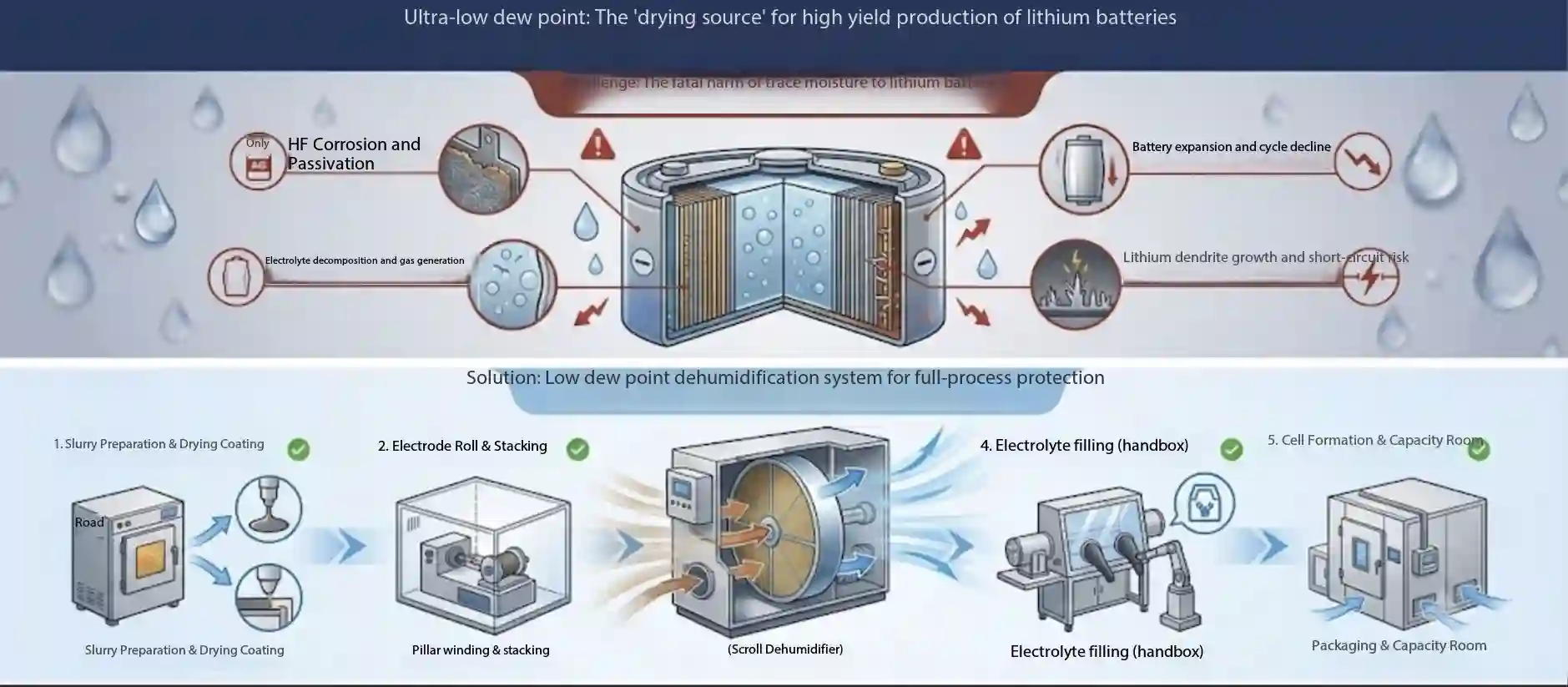
Ultra-low dew point dehumidifiers help lithium battery manufacturers control moisture in battery dry rooms. As EV and energy-storage production expands, stable humidity control is essential for battery quality, performance and safety.
Even small amounts of moisture can negatively affect battery materials and manufacturing processes. For this reason, modern battery factories rely on low dew point dehumidification systems to maintain ultra-dry production environments throughout the manufacturing process.
Why Is Moisture a Problem in Lithium Battery Production?
Many battery materials, including electrolyte solutions and active electrode materials, are highly sensitive to moisture.
When water vapor enters the production environment, it can trigger unwanted chemical reactions that may:
- Reduce battery capacity
- Shorten cycle life
- Increase internal resistance
- Generate harmful gases
- Compromise product safety and reliability
To prevent these issues, lithium battery manufacturers maintain extremely low humidity levels inside their battery dry rooms using industrial desiccant dehumidification systems.
What Is an Ultra-Low Dew Point Dehumidifier?
A low dew point dehumidification system uses a desiccant rotor (desiccant wheel) to continuously remove moisture from the air, producing extremely dry conditions that conventional refrigeration dehumidifiers cannot achieve.
These systems are capable of maintaining dew points as low as -40°C, -50°C, or even -60°C, depending on the production requirements.
They are widely used in battery dry rooms where stable ultra-low humidity is essential for consistent manufacturing quality.
Benefits of Ultra Low Dew Point Dehumidifier
Improve Product Consistency
A stable low-humidity environment minimizes moisture absorption by raw materials, resulting in better product consistency and higher manufacturing yields.
Enhance Battery Performance
Reducing moisture contamination helps improve battery capacity retention, cycle life, and overall safety performance while minimizing the risk of internal defects.
Support Critical Manufacturing Processes
Low dew point air is essential during key production stages such as:
- Electrode preparation
- Cell assembly
- Electrolyte filling
- Cell sealing
- Battery aging and testing
Maintaining stable environmental conditions helps ensure each manufacturing step operates reliably and consistently.
Reduce Defect Rates
Strict humidity control significantly lowers the likelihood of moisture-related defects, reducing scrap, rework, and production losses while improving overall efficiency.
Applications in Lithium Battery Manufacturing
Today, industrial desiccant dehumidifiers have become an essential component of lithium battery production facilities.
They are widely used in the manufacturing of:
- Electric vehicle (EV) batteries
- Energy storage system (ESS) batteries
- Consumer electronics batteries
- Lithium-ion pouch cells
- Cylindrical battery cells
- Prismatic battery cells
Whether building a new battery factory or upgrading an existing production line, selecting the right low dew point dehumidification system is crucial for maintaining stable dry room conditions.
Conclusion
As battery technology continues to evolve, the demand for ultra-low humidity manufacturing environments will only increase.
A reliable low dew point dehumidifier not only protects moisture-sensitive materials but also improves product quality, manufacturing efficiency, and long-term operational reliability.
For lithium battery manufacturers, investing in an advanced industrial desiccant dehumidifier is no longer optional—it is a key factor in producing high-performance batteries that meet the highest quality standards.
ASHRAE Handbook – HVAC Systems and Humidity Control Resources
https://www.ashrae.org/technical-resources/ashrae-handbook