
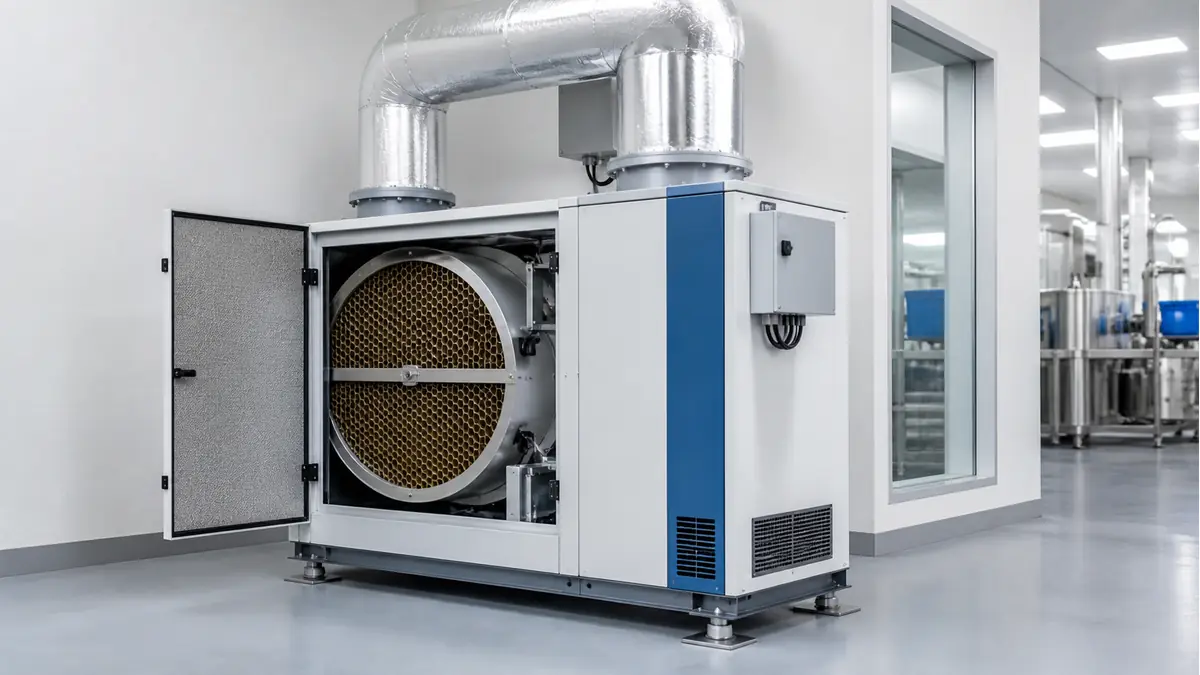
Mini desiccant dehumidifier selection should begin with the required humidity, airflow and moisture load. A compact unit is designed for industrial areas that need dependable humidity control but do not require a large central dry-room system. Its compact footprint makes it suitable for laboratories, electronics production, pharmaceutical rooms, small storage areas, pilot lines, testing rooms, and localized process-air applications.
Choosing the right unit requires more than comparing room area or nominal airflow. The target humidity, moisture load, inlet-air condition, duct arrangement, regeneration method, and operating schedule all affect actual performance.
What Is a Mini Desiccant Dehumidifier?
A mini desiccant dehumidifier removes water vapor with a rotating desiccant wheel. Humid process air passes through one section of the rotor, where moisture is adsorbed. A separate heated regeneration airflow removes the captured moisture so the rotor can operate continuously.
Because the process is based on adsorption instead of condensation, a compact rotary unit can maintain lower humidity at temperatures where a small refrigeration dehumidifier may lose capacity or experience frosting. Read our rotary dehumidifier working-principle guide for a detailed explanation of the airflow cycle.
When Is a Compact Desiccant Unit the Right Choice?
A mini system is useful when humidity must be controlled in a defined zone rather than throughout an entire factory. Typical examples include:
- electronics assembly and moisture-sensitive component storage;
- small pharmaceutical weighing, packaging, or laboratory rooms;
- pilot-scale lithium battery or material-development areas;
- instrument rooms and environmental test chambers;
- localized dry-air supply for machines, enclosures, or production processes;
- small warehouses, archive rooms, and corrosion-sensitive storage.
The compact format can reduce installation space and simplify localized ductwork. However, the equipment should still be selected from a moisture-load calculation rather than from floor area alone.
Five Inputs for Selecting a Mini Desiccant Dehumidifier
1. Required Relative Humidity or Dew Point
Define the target condition at the room, supply-air outlet, or process connection. A moderate relative-humidity requirement and a demanding low-dew-point requirement may need different rotor arrangements, airflow ratios, sealing standards, and regeneration temperatures.
2. Process Airflow
Required airflow depends on room volume, air changes, process exhaust, fresh-air volume, pressure control, and the way dry air is distributed. Excess airflow can waste regeneration energy, while insufficient airflow may produce slow recovery after doors open or production loads change.
3. Total Moisture Load
Include outdoor-air infiltration, ventilation air, people, open doors, wet products, cleaning, packaging materials, and moisture released by the process. Seasonal outdoor conditions should also be considered. A unit sized only from room dimensions can fail when the actual moisture load increases.
4. Regeneration Energy
Compact systems may use electric regeneration, while a customized installation may use another available heat source. The selection should consider energy availability, operating cost, temperature control, maintenance access, and production hours.
5. Installation and Controls
Confirm duct routes, filter access, drainage requirements for any pre-cooling section, noise limits, electrical supply, room pressure, sensor location, and connection to a building-management system. Variable-speed fans and demand-based control can help match output to changing production conditions.
Mini Desiccant vs Refrigeration Dehumidifier
A refrigeration dehumidifier cools air until water condenses. It is often economical for general humidity control at warmer conditions. A mini desiccant dehumidifier adsorbs vapor directly and is generally better suited to low humidity, low temperature, or applications that require stable dry-air delivery.
The choice should be based on the required outlet condition and total energy use, not only the purchase price. Some projects can also combine cooling and desiccant stages to manage both sensible heat and moisture efficiently.
GOZ Mini Desiccant Dehumidifier Options
GOZ provides a mini desiccant dehumidifier series for compact industrial humidity-control duties. Available configurations include the compact GZW-100L mini desiccant dehumidifier and the higher-capacity GZW-300L mini desiccant dehumidifier, together with additional models for different airflow requirements.
For a reliable recommendation, provide the required temperature, relative humidity or dew point, room dimensions, fresh-air volume, process exhaust, estimated moisture sources, installation restrictions, and available regeneration power. GOZ can then evaluate the load and recommend an appropriate configuration.
Frequently Asked Questions
Can a mini unit achieve a low dew point?
It can support low-humidity and low-dew-point duties, but the achievable condition depends on inlet air, rotor type, airflow arrangement, regeneration temperature, air leakage, and system design.
Can it operate continuously?
Yes. The desiccant rotor continuously moves between the process and regeneration sections. Filters, seals, heaters, fans, sensors, and airflow should be inspected according to the maintenance plan.
What project data should be supplied to the manufacturer?
Provide the target condition, room and airflow data, maximum outdoor condition, operating schedule, moisture-generating processes, utilities, duct limitations, and required control interface. Complete input data helps prevent both undersizing and unnecessary oversizing.