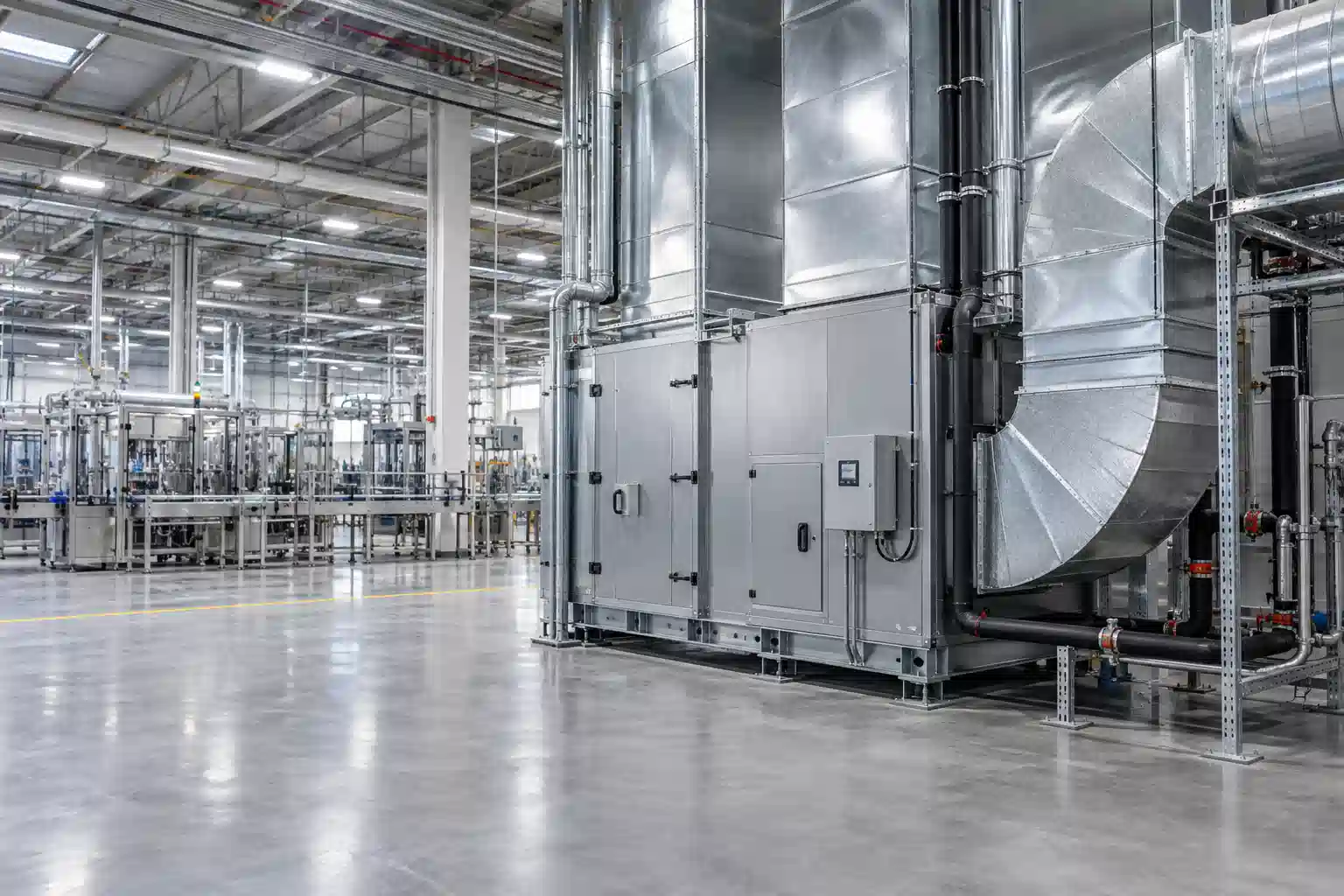
An industrial humidity control system is an engineered combination of dehumidification equipment, air handling, controls and distribution designed around a production process. The right system is selected from the required relative humidity (RH) or dew point, moisture loads, airflow and operating conditions—not from floor area alone. GOZ designs industrial humidity-control solutions for manufacturing, storage and moisture-sensitive production environments.
What an industrial humidity control system does
Industrial facilities need humidity control when excess moisture affects product quality, process stability, material handling, equipment reliability or building conditions. A system manages moisture in the air and helps maintain the environmental range required by the process. Depending on the project, it may also coordinate temperature, fresh air, filtration and room pressure.
The design objective should be stated in measurable terms: target RH or dew point, air temperature, airflow, operating schedule and the areas that must be controlled. A clearly defined target helps engineers determine the equipment type, capacity and control strategy.
Core components of an industrial humidity control system
- Dehumidification equipment: Refrigeration-based units can suit many general industrial spaces. Desiccant systems are often considered where low dew points, lower temperatures or year-round moisture removal are required. Final selection depends on inlet-air conditions and the required process target.
- Air handling and distribution: Fans, filters, coils, ducts and supply/return arrangements move treated air to the zones that need control. Air distribution should account for room layout, process equipment and potential short-circuiting.
- Regeneration or heat source: Desiccant systems use a separate regeneration process to release captured moisture. Available electrical, steam or other site energy can affect system configuration and operating cost.
- Sensors and controls: RH, temperature and, when relevant, dew-point sensors provide feedback for automatic operation. Sensor location and calibration matter because readings should represent the controlled process area.
- Integration and commissioning: The system may need to coordinate with existing HVAC, exhaust, fresh-air, production and building-management equipment. Commissioning checks airflow, control response and the achieved conditions under defined operating conditions.
How to select the right system
A reliable industrial humidity control system starts with a complete project brief. Engineers typically review:
- Required condition: Current and target temperature, RH or dew point, including acceptable variation and where it is measured.
- Moisture loads: Product and process moisture, people, wet cleaning, open doors, air leakage, fresh-air intake and exhaust make-up.
- Space and airflow: Room dimensions and zoning, supply and return locations, required air changes, pressure relationships and equipment obstructions.
- Operating profile: Production schedule, seasonal conditions, start-up expectations and whether the system runs continuously or by shift.
- Site utilities: Available electrical capacity and voltage, heating or regeneration energy, cooling water if applicable, drainage and installation access.
- Environmental constraints: Ambient temperature range, dust, corrosive conditions, cleanliness requirements, noise and maintenance access.
- Verification plan: The points and duration for measuring performance, the production state during testing and the acceptance criteria agreed for the project.
Room area alone cannot determine equipment capacity. Two rooms with the same floor area can have very different moisture loads because of air exchange, process materials, production schedules and target conditions.
Choosing between refrigeration and desiccant dehumidification
Refrigeration dehumidifiers remove moisture by cooling air so water condenses. They can be appropriate for many room-temperature applications where the required humidity target and operating conditions fit the equipment range. Their performance depends on entering-air temperature and humidity.
Desiccant dehumidifiers adsorb water vapor onto a rotating desiccant material and use a separate regeneration airstream to remove that moisture. They are commonly evaluated for low-dew-point processes, lower-temperature environments and applications where stable dry air is needed across changing conditions. Regeneration energy and the overall air-handling design should be included in the selection.
Some projects combine technologies or integrate dehumidification with cooling, heating, filtration and ventilation. The choice should follow a load calculation and operating-cost review rather than a one-size-fits-all rule. Explore GOZ’s desiccant dehumidifier systems and industrial dehumidifier equipment for examples of available system types.
Industrial applications
Humidity requirements differ by process. A system for a dry room needs different targets and air treatment from one intended to reduce condensation or corrosion risk. GOZ’s application pages describe several project types:
- Lithium-battery dry rooms, where moisture-sensitive materials and process conditions drive low-humidity design.
- Shipyard blasting and marine coating, where dry-air planning supports surface preparation and coating operations.
- Pharmaceutical production, where area conditions must align with the product and facility requirements.
- Cold storage, where air infiltration and temperature differences can contribute to condensation and frost.
- Electronics manufacturing, where stable environmental conditions can support moisture-sensitive processes and equipment.
From requirements to a working system
A practical project sequence is to document the process target, estimate the moisture load, review the room and utilities, compare suitable technologies, then develop equipment and airflow arrangements. After installation, commissioning should verify the agreed measurements and control response. Maintenance access, filter changes, sensor checks and regeneration components should be considered during design.
For an initial engineering review, prepare the room dimensions, current and target temperature/RH or dew point, fresh-air and exhaust rates, moisture sources, production schedule, site location, available utilities and any layout drawings. More complete inputs help the engineering team assess the system scope and identify missing information early.
Frequently asked questions
Can an industrial humidity control system be sized from room area?
No. Area is only one input. Moisture sources, infiltration, fresh-air flow, process conditions, target humidity and operating hours also affect the required capacity and airflow.
When should I consider a desiccant system?
Consider it when the required dew point is low, when the process operates at lower temperatures, or when the project needs dry-air performance that should be reviewed against refrigeration-system limits. The final choice should be based on the design conditions.
What information is needed for a preliminary proposal?
Provide the application, room dimensions, current and target conditions, moisture sources, airflow requirements, operating schedule, site utilities and installation location. Drawings and process descriptions are useful when available.
Planning an industrial humidity-control project? Contact GOZ with your process conditions and project information to discuss a system designed around your application.
Related Products & Applications
standard desiccant dehumidifier · industrial humidity control applications